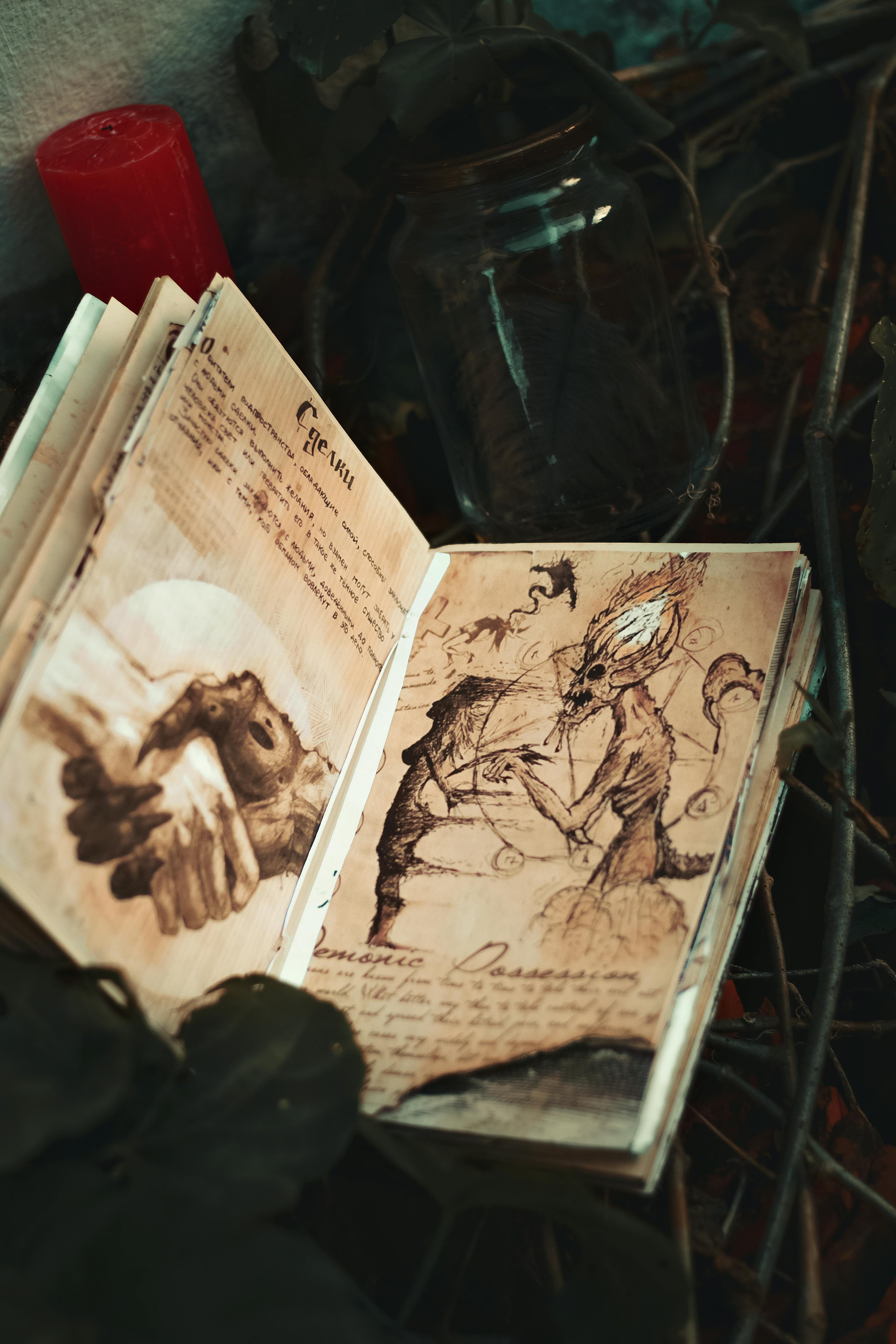
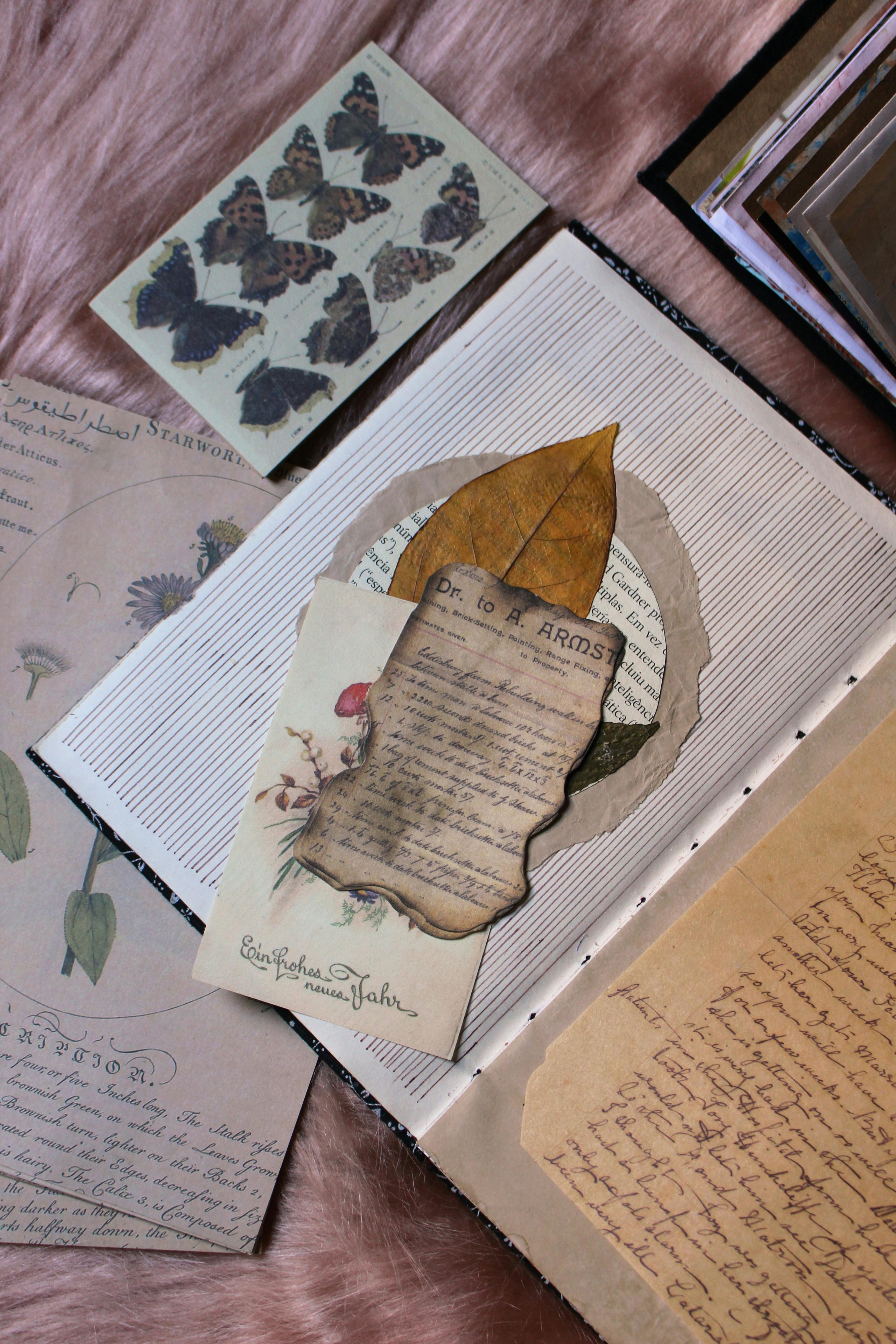
When you hear the word “grimoire,” what do you imagine? Is it something mystical and rough, like the above? Would it surprise you to know that it can look more like a journal or scrapbook, like the below?
Possibly descending from the French word grammaire, meaning ‘grammar’ or ‘learning’, a grimoire is a book with a variety of purposes and meanings across different cultures. The most basic understanding of a grimoire is a book dedicated to the occult lifestyle intended for use by one person. Grimoires commonly include spells, recipes, rituals, and other instruction for the craft. Some the earliest grimoires in history exist in the space between established religions, creating unique, countercultural practices.
The Greek Magical Papyri, one the oldest texts to meet the definition of grimoire, combines elements from Greek, Egyptian, and Jewish beliefs. Hans Dieter Betz, one of the document’s translators, describes how familiar figures from Greek belief such as Zeus, Artemis, and Aphrodite, are portrayed as dangerous figures, instead of as Hellenic aristocrats. This differing interpretation isn’t part of any established religious movement from the manuscript’s time period, which was somewhere between 100 BCE and 400 CE. Instead, the authors of the text are detailing their personal practices and ideas. That, in essence, is foundation of any effective grimoire.
Your grimoire should be a representation of you and your beliefs. Whatever you require to represent those ideas – drawings, diagrams, notes – should all be included in the book itself. Some grimoires are half sketchbook or scrapbook. Some aren’t books at all, but a digital diary. Whatever medium suits you best.
If you aren’t as interested in magical practice, that doesn’t preclude you from creating a grimoire of your own. Other grimoires are more akin to recipe books than anything else. A collection of daily knowledge considered sacred not for any association with spiritual power, but because of its sheer utility.
Throughout history, these personal records represent the knowledge important enough to be written down for personal use, but not respected widely enough for formal, academic documentation. This makes it a natural space for women’s knowledge to be recorded. Books written with no spiritual intent at all have been labeled ‘grimoires’ and ‘witchcraft’ as a way to discredit the knowledge held within them.
With that said, some words of warning about creating a grimoire.
When building a personal record, there is a temptation, even subconsciously, to self-mythologize. To relegate the secrets we hold dear as more important or more truthful than the beliefs or knowledge of those around us. In creating a grimoire, we give ourselves a tool to elevate our thoughts outside our mind and thus, elevate our self-esteem. We can become protective of that knowledge and defend it against outside ideas that might challenge our existing beliefs. There are few ways to create a grimoire incorrectly, but I would argue that using it as a shield against critical thought is incorrect. Your grimoire should grow and change with you. When the pages of one book fill up, it’s only natural to seek new space. In the same way, perpetual curiosity and the ability to challenge your own ideas are necessary to the creation of a strong grimoire.
It is also possible, however, to be too critical and secretive of the ideas one puts to paper. Your grimoire is not a teenage diary. Your personal writing is a not silly, diminutive practice. They are not worthless or meaningless.
Author Ursula K. Le Guin best describes the danger of women minimizing their personal writings and beliefs in her essay ‘What Women Know,’ published in her 2016 book Words are My Matter:
“But I didn’t and still don’t like making a cult of women’s knowledge, preening ourselves on knowing things men don’t know, women’s deep irrational wisdom, women’s instinctive knowledge of Nature, and so on. All that all too often merely reinforces the masculinist idea of women as primitive and inferior – women’s knowledge as elementary, primitive, always down below at the dark roots, while men get to cultivate and own the flowers and crops that come up into the light. But why should women keep talking baby talk while men get to grow up? Why should women feel blindly while men get to think?”
So write your grimoire. Put everything you have in it. Don’t let anyone disrespect the beliefs or knowledge you document there. And keep your mind open; keep cultivating a learner’s mindset.
Claire van Doren holds degrees in English literature and journalism as well as a certificate in LGBTQ+ studies from Arizona State University. She is a volunteer reader for Uncharted magazine, a publisher of genre fiction. Her writing has been published by Inner Worlds, Zocalo Public Square, and ASU News.

Inglenook Lit is an online literary magazine for magic enthusiasts and enchantment seekers
Copyright © 2021-2026
Inglenook Lit LLC

