Answer: A trial from 1474. (Among other things, allegedly.)
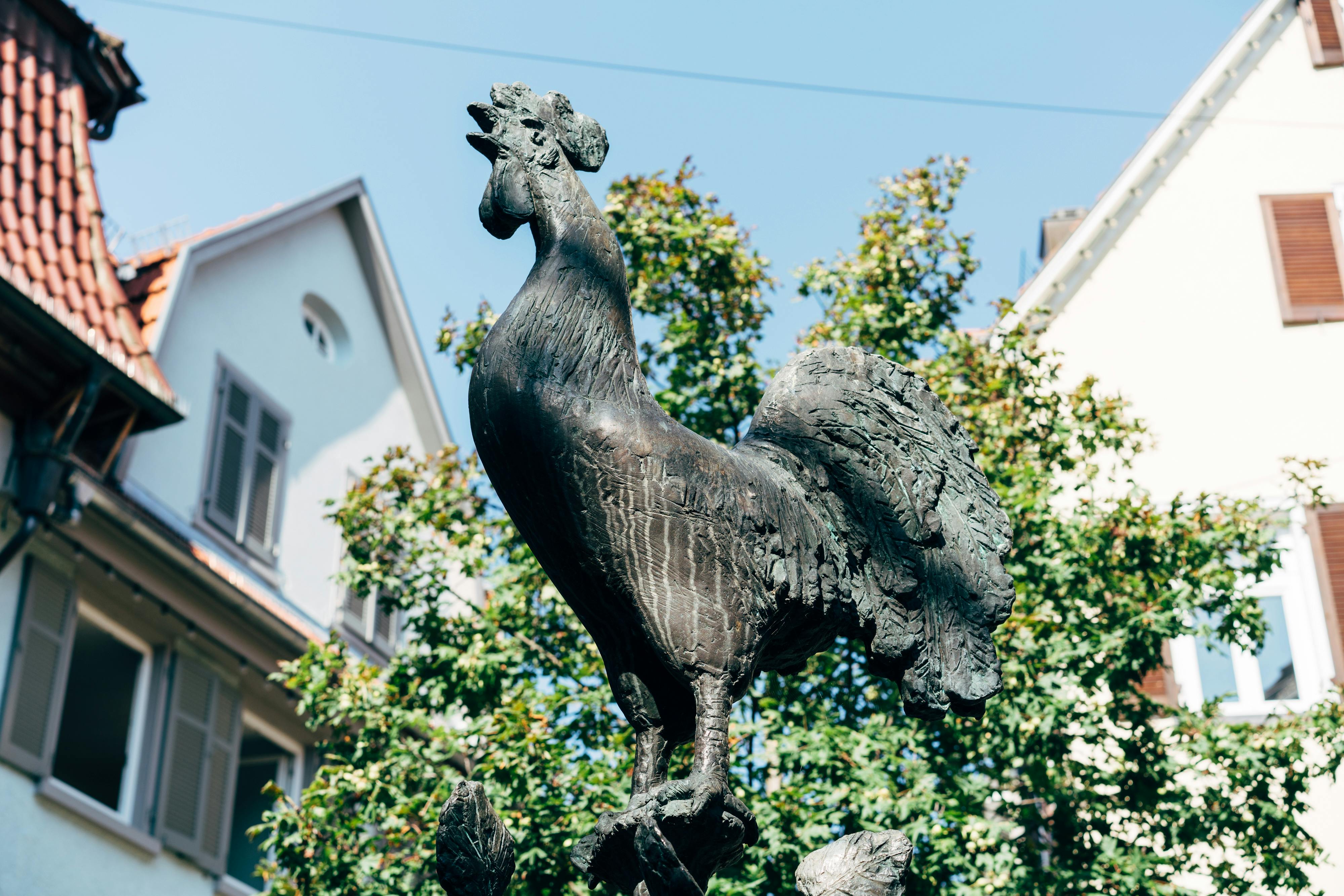
In 1474, in the good city of Basel, an independent city under the protectorate of the Holy Roman Empire, a rooster was burned at the stake for “witchcraft and defying natural law.” This account comes to us in 1626 in the Kurze Basler Chronik by Johannis Gross (1).
The rooster’s crime? Laying an egg.
Little is known of the actual proceedings of the trial or of the citizens gathered to watch the rooster and egg burn. But across Europe, witch trails in France, Germany and Switzerland were already preoccupying civil and ecclesiastic courts. Capital punishment in the former meant execution, but for the latter, it meant purification: the Devil must be forcibly driven out of the offending body.
What did witchcraft and Natural Law have to do with a rooster?
As the story went, when a rooster laid an egg and a toad or serpent hatched it, it would become a feared Basilisk: the king of serpents, a creature combining features of both animals and a gaze that could kill.
Few at the time could have known that the great Albert Mangus, in his work “de Animalibus” from the 13th century, had already doubted the Basilisk’s existence (2). “How,” the great scholar asked, “can we have so many eyewitness accounts of the Basilisk if its mere gaze kills the observer?”
The Basilisk’s popularity reached its apex in the city of Basel during the 15th century with a statue: a Basilisk holding the Baslerstab, Basel’s heraldic icon. Most agree that the city’s fascination with the creature derived from their homophony and common etymology: basileús (“king”) from which we have basilisk (little king) and Basel (royal city) (3,4).
There was also a story of a Basilisk being discovered in the city’s main fountain. The townspeople, fearing for their lives, ran in all directions. But not one Magdalena. Hearing that a Basilisk was on the loose, Magdalena polished the pail she had brought to fetch water. Gathering her courage, she bravely walked toward the Basilisk and, bearing her polished pail, deflected the deadly gaze back at the Basilisk: It shrieked, shriveled up, and died.
In the Late Middle Ages, the philosophical boundaries around the “order of things” were crumbling – the Reformation had made inroads into the one true apostolic church, along whose battlelines the salvation of the soul became the ideological point of contention. Meanwhile, in the city of Lucerne, dragon sightings—seen as harbingers of the plague—had reached their peak.
With this context in mind, we can now revisit the famous Basler Rooster Trial of 1474. The city authorities, amidst geo-political upheaval, were determined to apply the cold logic of law to a supernatural case. The rooster was given legal representation—as a creature of God, even a rooster deserved a voice—and the charges were carefully laid out. A rooster laying an egg is indeed an unnatural act, threatening people’s understanding of the natural order. Thus, the rooster and egg were sentenced to purification by fire.
How different is our moral imagination today. Cut off from the natural world, we would not dream of offering an animal legal representation. The rooster’s defense lawyer might argue that all beings great and small are creations of God, to which an Enlightened judge would only scoff, saying, “We have overcome such superstitions.”
In England in 1922, the January 6 issue of the Natural Poultry Journal (5) reported a case of a rooster laying an egg. This time, however, no tribunal was summoned and no bonfire laid. Instead, modern science has since shown that genetic mutations in roosters can indeed, in very rare cases, enable “egg-laying roosters.”
What change occurred between 1474 and 1922? One might say everything. Put more simply, “progress.” We now know that…etc. Max Weber has called this the “disenchantment of the world” (6). Animals, like much of nature, have a new, disenchanted inanimate reality – one that can be explained and dissected, no longer a part of God’s Creation. Plants, animals, rocks, all reduced to inert components to be reassembled by scientific order. Animals raised for the sole purpose of being eaten; plants grown exclusively for medicinal purposes; mountains being mined for their minerals to create smartphones.
And so, the mythical Basilisk cocks its rooster head, bobbing to and fro. But its gaze is no longer deadly, as no one bothers to look. An egg-laying rooster no longer draws the crowds it once did. We do NOT burn roosters at the stake, says the post-modern judge emphatically. But we do corral them into purpose-built coops for the sole purpose of becoming our dinner.
If given the choice, what would the rooster choose: myth, or the current order of things?
References
Douglas MacKevett

Inglenook Lit is an online literary magazine for magic enthusiasts and enchantment seekers
Copyright © 2021-2026
Inglenook Lit LLC


