***
The manila envelope had been sealed with a single strip of tape, its adhesive yellowed and brittle with age. On the front, in handwriting so small and deliberate it looked almost typed, were the words:
FOR LOIS. IN THE EVENT OF.
That was all. No object followed the phrase, nothing to complete the thought. But the event had come all the same. Edward Cranston was dead, and Lois Messler stood in her kitchen holding the envelope while his niece from Tucson set a cardboard box of ceramic birds on the counter.
Three years earlier, Edward had come across the yard in his slippers, the ones worn so thin at the soles that the shapes of his toes showed through, and spoke to her with quiet urgency, as if revealing a secret of national security.
“There’s an envelope,” he’d said. “If something happens to me, you need to make sure you get it. I’ll mark it with your name.”
“What is it?”
“You’ll know when you see it.”
For three years the knowledge of the envelope sat in the quiet corner of her mind where one stores other people’s unfinished sentences. Sometimes she thought about asking him again what it was, but the moment never quite arrived.
And now he was dead.
His niece from Tucson had called that morning to say she was clearing out the house and did Lois want any of the ceramic birds from his collection. Lois had said no, thank you. She didn’t ask about the envelope. It didn’t feel like her place.
But that afternoon the niece knocked on her door and handed it to her.
“It had your name on it,” she said. “I figured you should probably have it.”
Then she opened the box on the counter and lifted out a ceramic canary.
“You should take one of these, too,” she said.
“Oh, that’s alright,” Lois replied.
“Really,” the niece said, already placing the bird in Lois’s hand. “He had hundreds of them. It would be a shame for them all to end up at Goodwill.”
Lois turned the little canary over in her palm. Its wings were tucked tight against its sides, its beak lifted slightly as if it were about to sing.
“Well,” she said. “Thank you.”
The niece closed the lid of the box and slid it back toward herself.
“There’s a lot more of them if you change your mind,” she said. “I’ll be over there all week.”
The niece stepped onto the porch, pulling her phone from her pocket, and crossed the yard toward Edward’s house, tapping at its screen with her thumb. Lois reminded herself to ask her tomorrow about the funeral arrangements.
She closed the door and set the ceramic canary on the counter beside the sink. Then she turned the envelope over in her hands, feeling the stiffness of the old paper and the brittle strip of tape still clinging to the flap.
Inside was a stack of papers, their edges softened with handling. Lois slid them out onto the counter and squared them into a neat pile.
They were meeting minutes, typed on what appeared to be three different machines across several decades. Lois could tell from the way the letters aged on the page. The earliest sheets were struck in a heavy serif font, the e’s sitting slightly higher than the rest of the line. Later pages shifted to a cleaner typeface. The most recent had been printed from a computer but formatted to resemble a typewritten page, which struck Lois as a deliberate choice.
The first page was dated November 14, 1983, 11:47 PM.
MINUTES OF THE REGULAR MEETING OF THE COUNCIL OF THE NINTH LANE
Location: Under the Porch of 4002 Ninth Lane (Cranston Residence)
Members Present: Chairman Soot, Vice Chairman Princess, Treasurer Whiskers, Secretary Paws
Members-at-Large: Biscuit, Tom-Tom, The Orange One
Members Absent: None
Called to Order at 11:47 PM by Chairman Soot.

Approval of Previous Minutes: Vice Chairman Princess moved to approve. Seconded by Treasurer Whiskers. Approved unanimously.

Old Business:
1.  The matter of the raccoon incursion along the east fence has been resolved. Biscuit reports the raccoons have relocated to the alley behind Moorefield after a brief but spirited engagement. No further action required.
2.  The tuna situation at 4008 (Lockheart residence) continues. Tom-Tom notes that Mrs. Lockheart has switched from chunk light to albacore, which represents progress. Motion to table further discussion until the spring session. Approved 5–2, with Biscuit and The Orange One dissenting.

New Business:
1.  Chairman Soot raises the issue of a new dog at 4000 (Johnston residence). Breed appears to be some manner of Labrador. Disposition is enthusiastic. Threat level assessed to be moderate, primarily to dignity. Motion to establish a monitoring committee. Approved unanimously.

Adjournment at 12:31 AM. Next meeting to be held at the regular time and place.

Respectfully submitted,
Secretary Paws
Lois sat at her kitchen table and read the entire folder. It took two hours and the rest of a bottle of wine she had opened three days earlier, a little sour now but still serviceable.
She read forty years of minutes. Forty years of motions and seconds and amendments, discussions deferred to later meetings.
There was a motion to censure a cat named Brigadier for conduct unbecoming a member of the Council, specifically fraternizing with the dog at 4000. The motion passed six to one. Brigadier abstained.
There were records of the winter of 1989, when the snow stayed on the ground for eight days and the Council voted unanimously to suspend patrol boundaries and allow shared access to the dryer vent behind the Ramirez residence.
Territorial disputes were handled with the gravity of border treaties. The Great Squirrel Accord of 1991 occupied several pages of the minutes and appeared to have been negotiated over a series of tense autumn meetings. The conflict began when the squirrels in the large pecan tree behind 4009 expanded their foraging range into the Cranston yard. Chairman Soot described the activity as repeated and deliberate provocation, citing tail flicking, branch shaking, and what Secretary Paws recorded as mocking vocalizations.
Members Biscuit and Princess advocated immediate escalation. Treasurer Whiskers advised restraint, noting that a prolonged campaign might interfere with winter food acquisition.
The final agreement established a boundary along the wooden fence behind the Cranston property. Squirrels were permitted to use the power line but prohibited from descending into Council territory except in cases of nut-related emergency. Later minutes referenced continuing disagreements over the power line clause and at least one attempt at unilateral enforcement by The Orange One.
There was also the koi pond incident of 1997, recorded at great length and with considerable disagreement about whether the new Treasurer Chaos had fallen in voluntarily or been pushed by The Orange One II.
In 2003 the Council conducted a brief but passionate debate regarding the laser pointer wielded by the child at 4006. After several demonstrations and what the minutes described as extensive field testing, the device was determined to be strategically deceptive and unworthy of pursuit.
Lois read supply reports: the predictable generosity of Mrs. Lockheart’s tuna, the intermittent reliability of the college student at 4002 who dispensed deli turkey, and the neighborhood children who occasionally distributed pieces of their lunches at the bus stop.
There were notes on weather and migration patterns. Spring meetings frequently included observations about birds. Autumn meetings contained long digressions about falling leaves.
She read the careful accounting of membership changes as new cats arrived and old ones disappeared. The deaths of members appeared as simple notations at the top of the next meeting’s minutes:
The Council observed the passing of Vice Chairman Princess who had served with distinction for eleven years. A moment of silence was held. The moment lasted four minutes, which was noted as a new record.
New members were inducted. Some arrived with fanfare, a full paragraph noting their qualifications, their territory, their temperament. Others appeared without ceremony, listed among those present as though they had always been there.
She found her own cat in the meeting minutes from March of 2019.
New Business:
1.  Motion to seat Pepper (4010, Messler residence) as a voting member, effective immediately. Chairman Munster notes that Pepper has met the residency requirement and demonstrates adequate commitment to the interests of the lane. The Orange One IV raises an objection regarding Pepper’s habit of sleeping through patrol hours. Chairman Munster responds that patrol hours are voluntary and that The Orange One IV is invited to take the matter up with his own conscience. Motion approved 8–1.
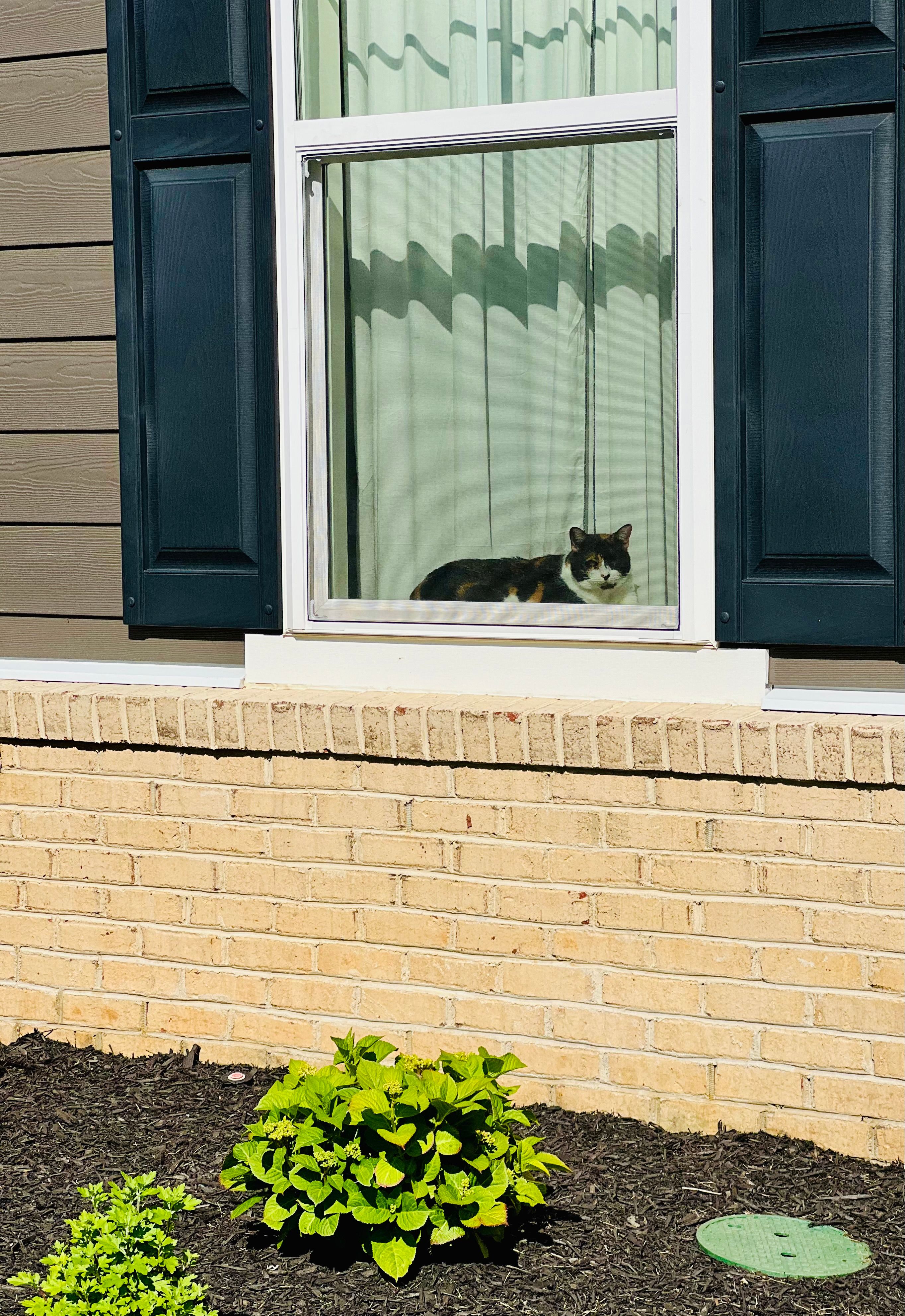
Pepper. Her Pepper. The tuxedo she had adopted in 2017. Who was, at that very moment, asleep along the back of the couch in a posture that suggested he had never attended a formal proceeding of any kind in his life.
Lois looked at him. Pepper did not look at Lois. She kept reading.
The Matter of Eleanor first appeared in the minutes from June 3, 2005:
Old Business:
1. THE MATTER OF ELEANOR. Chairman Brigadier II introduces the matter for the first time. Discussion is held. The nature of the matter is not recorded per standing order. Motion to revisit at the next meeting. Approved unanimously.
That was all. Lois turned the page, expecting clarification. There was none. At the next meeting, it appeared again:
Old Business:
2. THE MATTER OF ELEANOR. Discussion is held. Motion to confirm that Eleanor has not returned. Motion fails for lack of evidence. Motion to revisit at the next meeting. Approved unanimously.
And the next:
Old Business:
4. THE MATTER OF ELEANOR. Extended discussion. Secretary Mittens notes that the matter has now been under consideration for three consecutive meetings and asks whether a subcommittee should be formed. Chairman Brigadier II states that the matter is not suited to subcommittee and must be addressed by the full Council. Motion to revisit at the next meeting. Approved unanimously.
Lois went through every page.
The Matter of Eleanor appeared at every meeting from June 2005 through the final minutes in the folder, dated September 2024. Nineteen years. Roughly two hundred twenty-eight meetings. It was always listed under Old Business. Discussion was held but never described. The matter was never resolved.
Twice it was noted that the meeting had become heated. Once, in 2011, a member called The General requested that the matter be permanently tabled. The motion was defeated seven to two. The General did not appear at the next three meetings.
There was no Eleanor on Ninth Lane. Lois had lived there for twenty-six years. She knew every house, every family, every person who had come and gone. There had never been an Eleanor.
She thought about this for a long time.
The last entry in the folder was a handwritten note on a piece of lined paper torn from a spiral notebook. The handwriting was Edward’s. She recognized it from the labels he used on the tomatoes he left on her porch every August.
Lois,

I don’t know how to explain this, and I am not going to try.

I have been the secretary of the Council since 2003. Before me it was Estelle Lawrence at 4006, and before her someone named David who lived in your house in the 1980s. Secretary Paws has always been human. The rest of them are not.

The position will find you the same way it found me. You do not have to do anything. You only have to be willing to sit under the porch and type what they tell you. They are very particular about the minutes. They will know if you paraphrase too much.

About Eleanor, I do not know. Twenty years and I never figured it out. They will not tell you. I asked once and they put it to a vote. The vote was nine to zero against telling me, and Soot III said, and I am quoting directly, “The secretary is essential but the secretary is not the Council.” I considered being offended, but it was the most any of them had ever said to me in one stretch, so I let it go.

I know this sounds like the sort of thing an old man invents because he is frightened and wants to believe the world holds more than he can see. I considered that. In the end I decided it does not matter if that is what it is. Twenty years of sitting under a porch in the dark, writing down what the cats say, was the best thing I ever did with my evenings, and I’m grateful for it.

Meetings are held on the first Thursday of the month. They start late. Bring a laptop. Wear something warm.

Edward
Lois set the meeting minutes on the table. She finished the wine.
She looked at Pepper, who had shifted along the back of the couch so that one paw hung over the edge in a posture that could have been boneless relaxation or a very small gesture of acknowledgment. She could not tell which.
It was October. The first Thursday was six days away. She had a laptop. She had a coat. She had a stack of Edward’s meeting minutes and his yellow ceramic canary.
She had lived on this street for twenty-six years, and Edward Cranston had lived there for forty. In all that time, the cats had been meeting. Taking attendance, holding votes, tabling discussions, passing motions, observing moments of silence for their dead. They had been running a government, or something like a government, or something that wanted so badly to be a government that the difference no longer mattered.
And for twenty years they had been carrying a question they could not answer, bringing it back meeting after meeting like a stone they could not set down.
Lois thought about all the ways people gather, in churches and town halls and living rooms and parking lots after funerals, and how the gathering is never really about the agenda, but about returning. Showing up again to ask the question. The question was worth carrying another month, another year, another nineteen years. Not because anyone expected an answer, but because the asking mattered.
Pepper dropped from the couch and walked to the back door. He sat in front of it with his tail wrapped neatly around his feet. He did not meow. He did not scratch. He simply sat there, facing the door, looking at her as if something had already begun.
“All right,” Lois said.
But she did not know what she was agreeing to.
She suspected that was the point.
Kendra Kvale is a playwright and fiction writer based in Texas. She has nineteen plays published with Pioneer Drama Service and is the recipient of the American Alliance for Theatre and Education Distinguished Play Award. She shares her home with seven cats, all of whom she suspects have served on the cat council at one time or another.

Inglenook Lit is an online literary magazine for magic enthusiasts and enchantment seekers
Copyright © 2021-2026
Inglenook Lit LLC

