Magical literature is not only reserved for the genre of fiction; throughout history, it has been written from personal experience and retrieved from memory. Accounts of magical experiences are ubiquitous throughout history, but it is perhaps the memoirs of pious women in the Middle Ages that are best remembered for their “magical” experiences, which can only be described as out-of-body, otherworldly, and ineffable.

After a near-fatal illness in which she received sixteen visions of the Passion, Julian retired to an anchorite’s cell and spent decades working out what she had seen. In one vision, she watches Christ’s body change color as it dries on the cross. In another vision, she sees a lord and a servant in a parable. Years later, she comes to realize the parable as an allegory for God and His creation, whom he loves to care for when they suffer. She sat with these visions for twenty years in a sealed cell before writing them down, and what she produced is one of the most quietly radical theological texts in English, insisting, in the height of the Black Death, that God is not wrathful and not punishing. She suggests that God is perhaps best understood as a mother, a stark contrast from the prevailing understanding of God.
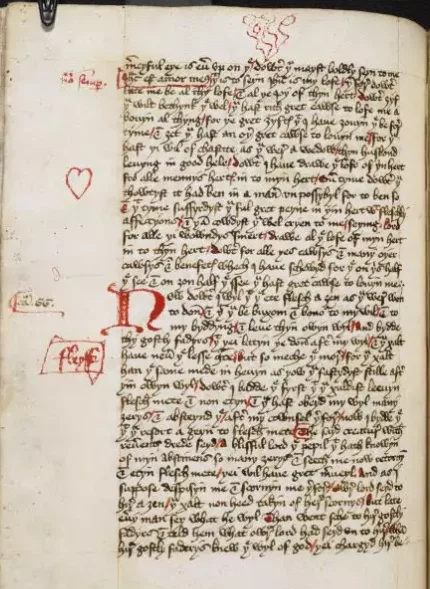
Generally considered the first autobiography written in English, The Book of Margery Kempe is remarkable for its honesty. Margery writes about herself in the third person—“this creature”—humbling herself before God. She recounts moments of divine revelation through visions of biblical figures, including sensuous descriptions of her relationship to Jesus Christ. Her own life biography is equally fascinating; to dedicate herself more fully to Christ, she requested from her husband that they terminate their sexual relationship. Margery of Kempe is known famously for her deeply embodied experiences of God, weeping uncontrollably in recognition of Christ’s suffering his love for her.
Around the age of 50, St. Teresa of Avila, perhaps the most well-known of mystic women in the Western world, wrote an account of her internal mystical experiences. At age 20, she entered a Carmelite convent despite her father’s disappointment. After two decades of ascetic and contemplative practice, St. Teresa underwent transverberation—an experience of being “pierced through” the heart through divine intervention. She describes a vision of an angel driving a golden spear into her heart repeatedly, leaving her simultaneously in agony and “on fire with a great love of God.” Bernini would later sculpt this scene in marble, and the marble is almost as startling as the prose. Teresa wrote The Life under orders from her confessor, which may be why it has the quality of someone telling the truth under mild duress, but the honesty of her story reverberates and inspires today.

Hildegard began receiving visions as a child and spent most of her life hiding her experiences from the public. At forty-two, she heard a divine voice instruct her to write down what she saw, and the result — Scivias, short for Scito vias Domini, “Know the Ways of the Lord” — is one of the most visually extraordinary texts of the medieval period. Less narrative or autobiographical than the other works mentioned, the visions are overwhelming in scale: a luminous figure seated in a sapphire-blue throne, a wheel of winds and fire representing the universe, a mountain of iron from which a figure blazing like the sun emerges. Hildegard did not only transcribe these images; she painted them, composed music to accompany them, and built an abbey. Scivias is where the visions begin, and it reads less like a spiritual memoir and more like someone reporting back from a place the rest of us cannot see.
***
These women’s experiences might have more relevance and potency now than in their own time. The uniqueness of their mystical encounters was questioned and criticized during their lives and for many centuries afterward. But now, centuries of mystical accounts have accumulated into an ever-growing body of literature, challenging contemporary readers to extend the boundaries of spiritual understanding. Most of us may not experience the world-shattering phenomena these women did, but their testimonies may help us better understand those fleeting moments that move us closer to the divine.
Tara Yazdan Panah is an essayist from Carlsbad, CA, and an Inglenook Features Writer. She is currently based in Cambridge, MA, where she works as a teaching fellow at Harvard Divinity School.

Inglenook Lit is an online literary magazine for magic enthusiasts and enchantment seekers
Copyright © 2021-2026
Inglenook Lit LLC


