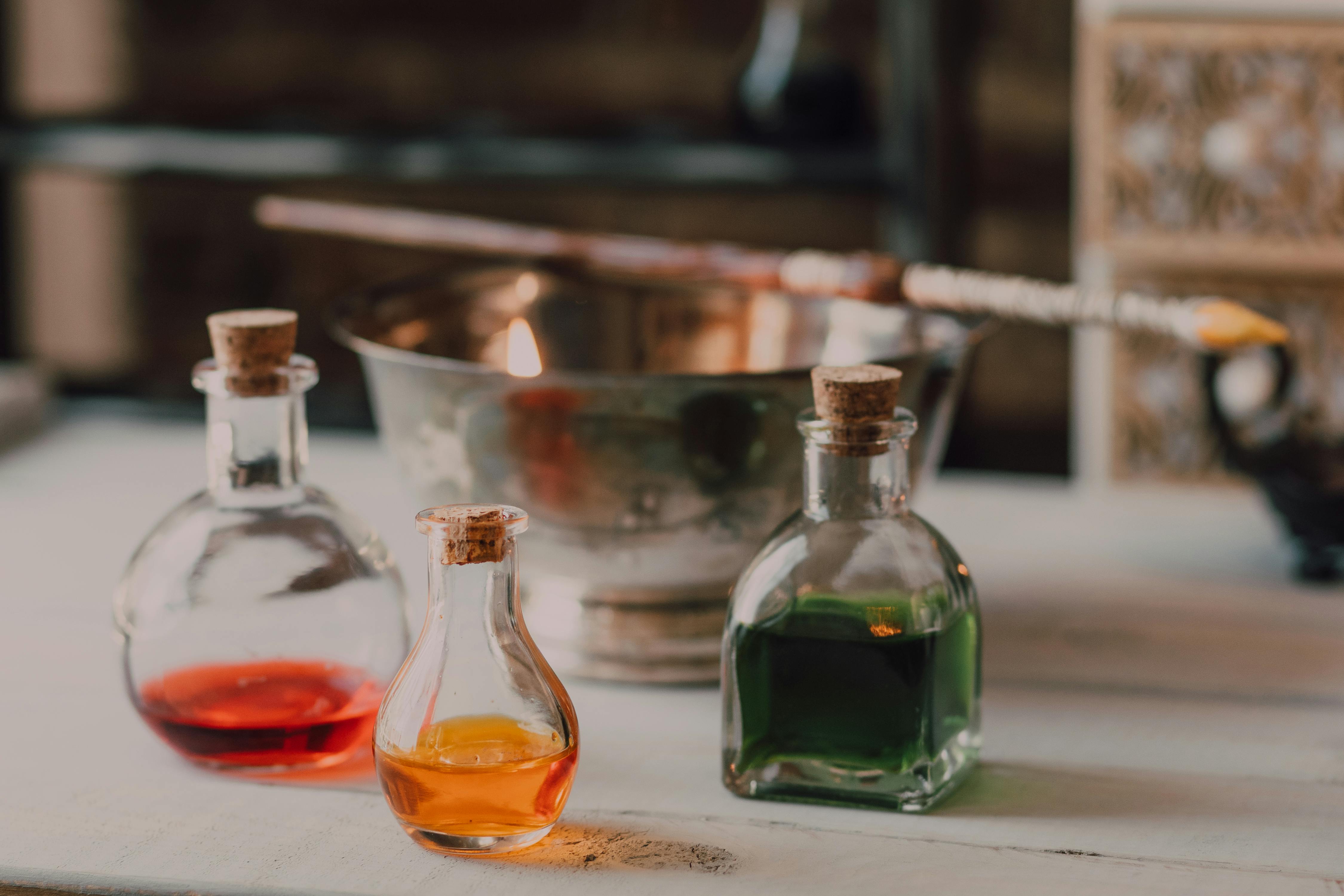
Before there were chemists, there were alchemists. In fact, the two “sciences” come from the same root word, chem, which may be derived from the Ancient Egyptian term keme (black earth, a reference to the dark, fertile soil of the Nile) or the Greek chyma (to cast/pour together). It is unclear when the practice of alchemy took shape, but it is most associated today with the Middle Ages.
The traditionally understood goal of alchemy is transmutation: to take one metal element and transform it into another. For most alchemists, that element was gold. Basic 21st-century understandings of chemistry tells us that such a feat is physically impossible. Other alchemists pursued less material goals, like immortality. But in pursuing a futile mission, what did alchemists gain, spiritually?
Alchemy was fundamentally a soul-searching activity
Perhaps alchemy is better understood as art than as science. Alchemists certainly used knowledge from biology, astronomy, and medicine and used scientific instruments you might find in a lab. But alchemists also used artistic techniques one would find in metalworking, pigment-making, and dyeing. It also involved deeply human elements like mysticism and philosophy to guide the alchemist’s intuition and experiments. Alchemy is most like art, however, mainly in that it holds process and creation at its core. A work of art does not just sit passively as it is being molded. The artistic process is recursive, and therefore, the artist is transformed, too.
Carl Jung saw the arcane art of alchemy as a mode of projecting unconscious psychic processes onto the transformation of matter. In other words, the feat of turning lead into gold reflects the alchemist’s inner transformation into a realized “Self,” reckoning with aspects of their identity that are in the process of integration. The same can be said for any creative act. An artist’s work is an extension of their psyche, especially when conducted in a state of complete authenticity in a therapeutic setting. Jung said that art created in a meditative state, when the unconscious imagination was most open, could give way to powerful self-healing: “by painting himself, he gives shape to himself.”[1]
Alchemy was fundamentally a soul-searching activity amongst the most esoteric of society. Its instruction was often passed through symbolic codes and imagery, so its occultist associations ought to be no surprise, and still last to this day. Contrary to popular belief, alchemy is not a “dead” art. It is alive within certain Neo-Pagan, New Age, and witch communities. Take, for instance, The Alchemical Academy, a school of alchemy in Stockholm, Sweden. Their most common practice is mixing elixirs of herbs and metals, which can provide spiritual and health benefits. The goal in making these elixirs, however, is to attain “The Philosopher’s Stone,” an embodied mystical knowledge. The members of the academy view the materials as a “magical mirror” to the self, and make inner transformations visible to the outer world. In a way that combines art and religion, alchemy functions as both experiment and ritual.[2]
Alchemical practice provides a helpful language for the spiritually and artistically inclined who want to develop their sense of self and relationship with the divine. Despite the existence of passed-down “recipes” for gold or the Philosopher’s Stone, the pursuit of these treasures requires immense trial and error on the part of the alchemist, with no guarantee of success. With alchemy, as with art, temperance and self-knowledge are needed to harmonize elements. Over time, you can learn to love the process of creation, even if the product is just a fantasy.
[1] C. G. Jung, “The Aims of Psychotherapy,” in The Practice of Psychotherapy, trans. R. F. C. Hull, 2nd ed., vol. 16 of The Collected Works of C. G. Jung, ed. Herbert Read, Michael Fordham, and Gerhard Adler, Bollingen Series XX (Princeton: Princeton University Press, 1966), par. 106.
[2] Cejvan, Olivia. “Initiatory Materials: An Ethnography of Contemporary Alchemy in Sweden.” Correspondences: Journal for the Study of Esotericism 6, no. 1 (2018): 25–45.
Tara Yazdan Panah is an essayist from Carlsbad, CA, and an Inglenook Features Writer. She is currently based in Cambridge, MA, where she works as a teaching fellow at Harvard Divinity School.

Inglenook Lit is an online literary magazine for magic enthusiasts and enchantment seekers
Copyright © 2021-2026
Inglenook Lit LLC

