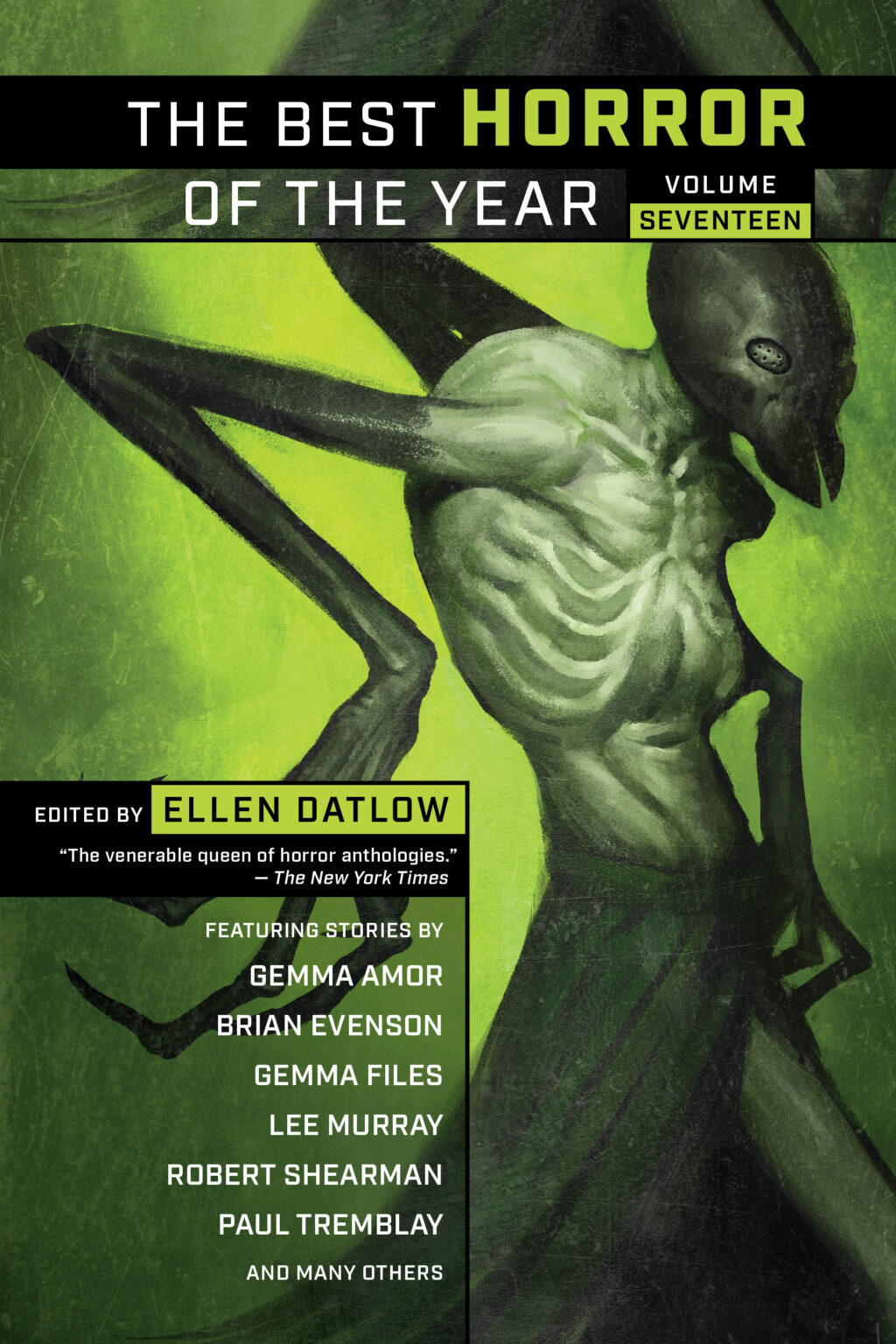
With more than 45 years of experience, Ellen Datlow is unquestionably one of the most impactful editors working in fantasy, science fiction, and horror today. She’s acquired numerous short pieces for magazines and anthologies and has been recognized for her work by many literary institutions. She’s received three Shirley Jackson Awards, three Bram Stroker Awards, and ten World Fantasy Awards over the course of her career. From Datlow’s early reading habits to her projects, this interview attempts (in vain) to span a lifetime of incredible work.
Inglenook: I’d love to start by learning about your early inspirations. What did you read as a child that inspired this life-long love of horror and speculative fiction?
ED: I’ve always been a reader of fantasy, science fiction, and horror. As a child I read the genre classics that my parents had on their bookshelves and that I took out from the library (like The Odyssey–I found The Iliad boring), Nathaniel Hawthorne and Guy de Maupassant stories, many of the Andrew Lang fairy tale books. Bullfinch’s Mythology. Later I devoured the collections of Ray Bradbury, Richard Matheson, Harlan Ellison, H.P. Lovecraft, and others. And I watched the original Twilight Zone, Night Gallery, The Outer Limits, One Step Beyond on television as a kid.
Inglenook: Why short fiction? What does the medium bring to speculative fiction that others (novels, movies, shows) can’t?
ED: Most of my reading in the fantastic / horror genres was always short fiction collections and anthologies. I have no idea what got me interested in them—maybe the fairy tales I read and that my mother read to me. I love reading stories that can be read in one sitting. And of course, it can provide a short, sharp, shock, something longer fiction cannot.
Editing short fiction is usually more straightforward than editing novels. I started editing novellas several years ago for Tor.com and Nightfire (the Tor horror imprint) and sometimes it can be a struggle for me when they’re long novellas, overlapping with short novels. I’m not as skillful as I’d like to be with regard to structure, and that’s crucial in editing longer novellas.
Inglenook: Are there any female editors or other publishing professionals who inspired your career path?
ED: Judith Merril, the famous sf editor of the 50s and 60s. Also, the male editor Maxwell Perkins.
Inglenook: Ursula K. le Guin once described science fiction as “one of the central fictional modes of our century,” while arguing that genre labels like ‘classic literature,’ ‘science fiction,’ and ‘fantasy’ have been used to exclude both women and speculative writing from literary canon. Do you feel that genre fiction is undervalued by critics? Or is it something that’s changed over the course of your career?
ED: Labels have mostly been used by publishers to market books. That might have been useful in the past from a sales viewpoint but it was also demeaning to all genres not considered “literary”—which is itself a genre.
Now, there is so much crossover between genres and readers of various genres, that labelling books as one genre or another is not particularly helpful to anyone. Horror is a case in point, far more than science fiction. Science fiction needs to at least be about the repercussions of science, technology, etc on the future—it’s an external influence.
Horror is everywhere—it encompasses every other “genre”-there’s sf/horror/gothic/body horror/psychological horror/monsters, erotic and sexual horror, etc. The barriers for horror have broken wide open, especially now that a horror novel (Angel Down by Daniel Kraus) has won the Pulitzer Prize for fiction.
Inglenook: The landscape of publishing has changed over the course of the last few years with the popularity of social media marketing. Has that impacted your work in short fiction? I know you typically solicit work for your anthologies. Do you use social media as a tool to find new writers or do you stay away from it?
ED: I’m on social media, mostly because it’s a connection to my friends (and readers). The only impact on me is wasting my time doom scrolling (laughing). As far as affecting my work, no. I discover new writers by my regular reading for the Best Horror of the Year or via word of mouth. Although if I want to reach a writer who I don’t know personally, it makes it easier to contract them directly, rather than having to go through their publisher or agent—which for me, is preferable.
Inglenook: How does your work with genre fiction, especially science fiction, inform your perception of AI? Do you view it as a threat to creative work or as a tool for writers and editors?
ED: It’s definitely a threat to writers and to editors—if publishers are so cheap or stupid that they think AI can be passionate and create. Or can take the place of editors. Every original piece of fiction I acquire is edited by me. I’m a substantive editor and a line editor. I work with the author and ask questions throughout the process. Do I think AI could do the same thing? Nah.
Copy editing is a different issue, and I’d leave the response to copy editors. A big problem with so-called writers using AI to write is that it’s made editors more suspicious of new writers’ work, which is a terrible thing.
A friend sent me a story by a student and it was so polished and intriguing that I asked my friend if he was sure the student hadn’t used AI to write it. He then assured me that the student showed him copious notes proving (to my friend) that he did not use AI to write his story.
Inglenook: Thank you so much, Ellen! One final question for you, do you have any current projects you’d like to share with Inglenook’s readers?
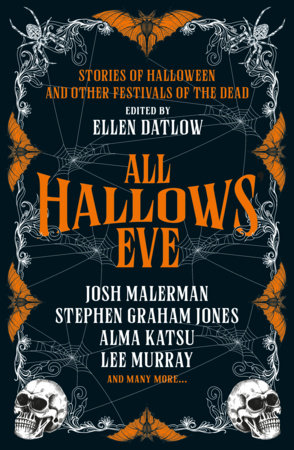
ED: I’ve got two or three anthologies coming out this year: Lovecraft’s Brood, an all reprint cosmic horror anthology coming out in July from Tachyon, All Hallows Eve, an all original anthology of stories centered around horror readers’ favorite holiday, out September 8th from Titan, and my annual The Best Horror of the Year Volume Eighteen, hopefully out by the end of this year from Night Shade.
***
Datlow’s dedication to her work serves as a reminder that passion, drive, and a critical eye are the main ingredients to a successful career in the literary world. Even as short stories and their authors face off against algorithms and large-language models, individual taste and style remain tantamount when an editor curates their list. With seventeen previous years’ experience selectingthe best horror of the year, I’d trust Ellen Datlow’s opinion over a computer’s any day.
Claire van Doren holds degrees in English literature and journalism as well as a certificate in LGBTQ+ studies from Arizona State University. She is a volunteer reader for Uncharted magazine, a publisher of genre fiction. Her writing has been published by Inner Worlds, Zocalo Public Square, and ASU News.

Inglenook Lit is an online literary magazine for magic enthusiasts and enchantment seekers
Copyright © 2021-2026
Inglenook Lit LLC

