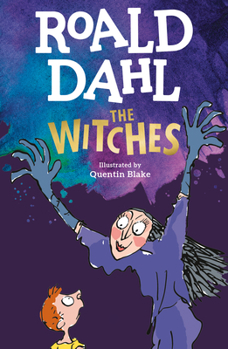
We have a bone to pick with Roald Dahl. It’s not that we don’t love his mischievous, real-world tale of witches lurking in 1980s England — we do. The Witches is a classic. It's suspenseful, adventurous, and filled with danger and vivid imagery. But Dahl’s witches are bald, clawed, square-footed, and “allergic” to children. They're more caricature than archetype. His portrayal taps into a centuries-old reflex: the instinct to fear and deform the image of powerful women.
How do you really spot a witch? Probably by not listening to Roald Dahl.
Dahl wasn’t alone in casting witches as grotesques. From the hooked-nose hags of Shakespeare’s Macbeth to the green-skinned monsters of The Wizard of Oz, literature and cinema have long used witches as mirrors for society’s discomfort with female autonomy. There's a long history of targeting (mostly) women who pursue power or display too much independence. Just as "witch" has been used to connote "evil," pointy black hats and broomsticks have been the hallmark symbols for abnormality. Offenders of the social order.
But not all of the so-called “marks” of a witch are as damning as they onced seemed. Many of these traits, from the broom to the hat and untamed hair, even the moonlight ride, are once again becoming symbols of freedom, transformation, and defiance, as more and more people embrace witchcraft and political activism.

Pop culture has never stopped reinventing the witch, from cackling villain in a chicken-footed house à la Baba Yaga to misunderstood mystic on a castaway island à la Circe. Each generation of creators and authors paints her anew, often revealing more about the anxieties of the time than about practicing witches themselves. Some good reads that cover this include Pam Grossman's Waking the Witch and even Nat Geo's latest issue, The History of Witchcraft.

That trademark emerald hue didn’t come from medieval folklore but from Hollywood’s Technicolor era. When The Wizard of Oz (1939) hit theaters, Margaret Hamilton’s Wicked Witch of the West was painted green to heighten her menace against the candy-colored sets. The effect worked so well that it became canon: the green witch as shorthand for female malice. But peel back the layer of greasepaint, and that green skin reads differently today, as otherness made visible, a cinematic scarlet letter for women who, like Wicked's Elphaba, refuse to conform.

The witch's broom is where things get more interesting, and is perhaps the most misunderstood of witchy tools. Some say the symbolic uses of the broom began with ancient pagan fertility rites, where women would leap astride poles or stalks of grain to bless the fields and encourage crops to grow.
Centuries later, as Christianity sought to sanitize folk rituals, the image of women “flying” on brooms became both slander and fascination, a fusion of domesticity and rebellion. The household tool that once swept hearths clean became a vehicle for transcendence, and for centuries since, the witch on her broom has been an emblem of women literally taking flight from their prescribed roles. There's also the theory that brooms are meant to take on phallic symbolism that brings to mind images of wild-eyed witches whipped up into carnal frenzies as they ride across the moonlit sky.
Modern-day witches use brooms as they were made to be used: for cleaning. Either to tidy up after a messy meal, or to energetically clear the space in preparation for a ritual.

The conical hat has a more direct link to politics and protest than the broomstick. The iconic conical, point-tipped hat associated with witches likely comes from Quaker style. Seventeenth-century Quaker women in England wore wide-brimmed black hats with tall crowns, a bold uniform for those who believed that women and men were spiritual equals. Their defiance of church hierarchy made them targets, and their distinctive hats soon became visual shorthand for heresy. The witch’s hat, then, is more than a costume. It’s a relic of courage, of women standing tall in the face of suppression. When it's not being used for Halloween, the witches hats of today come out for rallies and protest marches.

Before it was a punchline for “double, double,” the cauldron was just…a pot. The beating heart of the household hearth. In medieval Europe, a sturdy iron cauldron was a family’s most prized tool for boiling water, dyeing wool, brewing ale, and making medicine. That everyday centrality is precisely why it became charged: a vessel where raw ingredients turn into something new was an irresistible metaphor for knowledge and power, specifically female knowledge and power.
In early modern Europe, pamphleteers and woodcut artists clustered “night women” around a boiling pot, insinuating poisons and pacts. Shakespeare sealed the trope with Macbeth spell-casting witches, and from there, the cauldron bubbled into pop culture. In contemporary practice, the cauldron reclaims its older meanings. Modern witches use small cast-iron pots for herbal infusions, incense and resin work, burning petitions, and scrying (a dark, water-filled cauldron reflects like a mirror). It stands for the oldest magic of all: transformation. Food into nourishment, leaves into medicine, intention into action. If the broom is escape from constraint and the hat is dissent made visible, the cauldron is the proof that change is possible. It doesn’t hide monsters; it midwifes metamorphosis.
Today, witches in pop culture have traded warts for wit. From Samantha Stephens twitching her nose in Bewitched to the teenage coven of The Craft, the witch has evolved into a figure of self-determination, humor, and modern spirituality. She remains powerful, but she’s allowed to be beautiful, complex, and human too.

The simple answer? Go where the witches are. Start with your local crystal shop, occult bookstore, or herb apothecary, where the modern witch community thrives. Across the world, witches gather at festivals, retreats, and online events celebrating nature-based spirituality. The Gaian Fairy Congress, for instance, hosts annual gatherings (both virtual and on the U.S. West Coast) exploring the connection between humans and the unseen realms. In the U.K., Seed Talks and the London Arts-Based Research Centre invite scholars and practitioners to share the academic and artistic side of occult thought, while New York’s Occult Humanities Conference blends ritual with research.
For the historically curious, Salem, Massachusetts and Boscastle, Cornwall offer tangible (if touristy, in Salem's case) links to the past, including museums, trial sites, and memorials that remind us how fear of the feminine once turned deadly.
But most witches aren’t on display. They walk quietly among us as teachers, gardeners, artists, and healers. They honor the cycles of the moon, act kindly towards nature, and know that intention has power. They may not wear tall hats or ride brooms, but they practice the same old magic: reverence for non-human life, trust in intuition, and the courage to live authentically.
No green skin. No evil. Only heart-led intention. These are the witches we honor at Inglenook.


Inglenook Lit is an online literary magazine for magic enthusiasts and enchantment seekers
Copyright © 2021-2026
Inglenook Lit LLC

