Three daggers stab through a red beating heart like a child’s drawing—it’s almost comical— and a rainy storm looms in the background. The Three of Swords strikes most as a tarot card of doom. For those of us who consult the tarot regularly, it’s a dreaded card that we know too well, typically associated with heartbreak, betrayal, grief, breakups, and divorce—not a particularly attractive lineup of nouns. But, as with all cards in the tarot deck, this card might be a source of panic for some, and a source of clarity for others.

Tarot is most often used as a tool for divination: to answer questions about the future, finances, relationships, and other matters of the heart. Beyond a metaphysical act, consulting tarot can be an insightful and transformative process. It can even assist with the lifelong process of “individuation”: the Jungian term for coming into one’s sense of self, integrating the unconscious into the conscious.[1]
Carl Jung, the 20th-century psychologist, argued that universal archetypes that lie dormant in our psyche make up our collective unconscious, which accumulates over millennia and is manifested similarly across cultures globally. Take, for instance, the symbol of the Wise Old Man/Woman. In myths, folk tales, and theology, the image of this figure reverberates across the world, projecting as Athena, Merlin, Laozi, Yoda, Gandalf…the list goes on. Archetypes of transformation for Jung are “not personalities, but are typical situations, places, ways and means, that symbolize the transformation in question.”[2] Jung pointed to tarot as a useful example of how archetypes become tangible in material culture.
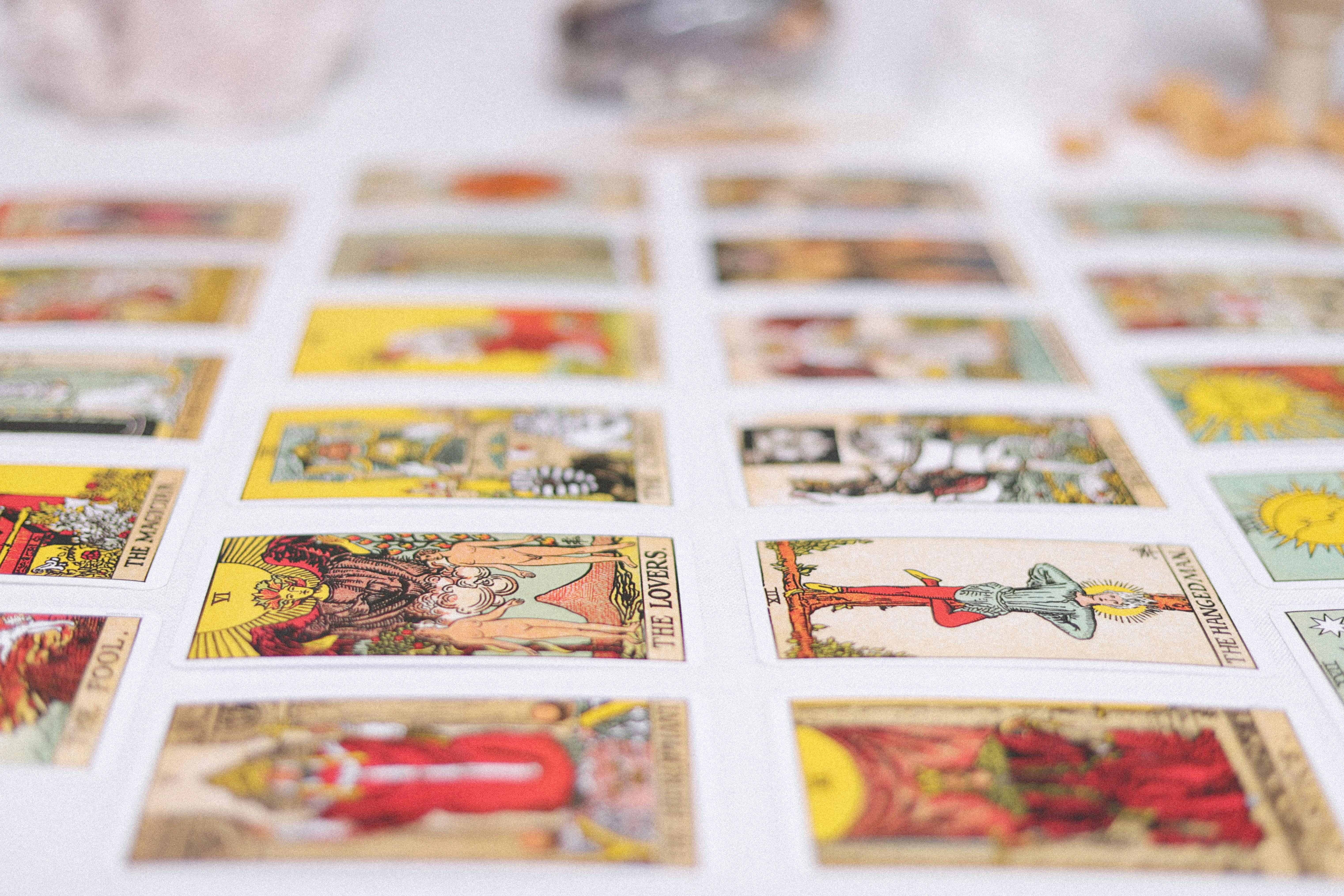
A typical tarot card deck has 22 Major Arcana cards, all of which bear some sort of archetypical image. Card 0 begins with the Fool; card 5 is the Hierophant; card 9 is the Hermit. In the traditional and most commonly used Rider-Waite deck, illustrated by Pamela Colman Smith, the Minor Arcana also features archetypical images like queens, pages, scales, and churches. In his book Archetypes and the Collective Unconscious, he says, “the set of pictures in the Tarot cards were distantly descended from the archetypes of transformation.”[3] The Hermit, then, might be a stand-in for the “Wise Old Man” figure, whose solitude and maturity have afforded him acuity and knowledge. For Jung, embedded deep within our unconscious lives some element of these archetypes, but it is up to us to figure out our relationship to them.
So what might a Jungian tarot reading look like? It is not so much concerned with what is occurring externally to the seeker. Whether there are greater forces at play determining which cards are drawn—towards the end of his career, Jung theorized that synchronicity was more than just coincidence—the cards hold up mirrors to the seeker’s unconscious, helping to make what is unseen conscious. To do so successfully requires active imagination. “Active imagination” is a Jungian meditation method that involves mental play with archetypical images of the mind. It is more intentional and self-confronting than simply daydreaming. It might involve the help of a professional, but it is certainly possible on one’s own. The key is to let the imagination loose, allowing associations and emotions to surface in response to the cards. One might prompt the imagination by asking: how might the archetypes represented on the cards be interacting with one another? Who or what might they represent in our lives?
If we go beyond our day-to-day wonderings and consider the deeper significance of tarot’s visual imagery, we can take steps towards regulating our inner worlds and embracing our innate strengths and wisdom.
[1] C. G. Jung, The Archetypes and the Collective Unconscious, trans. R. F. C. Hull, 2nd ed., Collected Works of C. G. Jung, vol. 9, pt. 1, Bollingen Series 20 (Princeton: Princeton University Press, 1968; repr., 1990), 40.
[2] Jung, Archetypes and the Collective Unconscious, 38.
[3] Jung, Archetypes and the Collective Unconscious, 38.
Tara Yazdan Panah is an essayist from Carlsbad, CA, and an Inglenook Features Writer. She is currently based in Cambridge, MA, where she works as a teaching fellow at Harvard Divinity School.

Inglenook Lit is an online literary magazine for magic enthusiasts and enchantment seekers
Copyright © 2021-2026
Inglenook Lit LLC

